3D Rigid Body Motion (2)
3. 3D Rigid Body Motion (2)
3.4 Quaternion
앞서 소개한 Euler Angle의 문제점을 보완할 도구로 Quaternion(사원수) 체계가 있다.
quaternion은 3개의 imaginary + 1개의 scalar으로 이루어져 있다.
\[\mathbf{q}=q_{0}+q_{1} i+q_{2} j+q_{3} k\]혹은 다음과 같이 표현한다
\[\mathbf{q}=[s, \mathbf{v}]^{\mathrm{T}}, \quad s=q_{0} \in \mathbb{R}, \quad \mathbf{v}=\left[q_{1}, q_{2}, q_{3}\right]^{\mathrm{T}} \in \mathbb{R}^{3}\]그리고 아래와 같은 성질이 있다.
\[\left\{\begin{array}{l}i^{2}=j^{2}=k^{2}=-1 \\i j=k, j i=-k \\j k=i, k j=-i \\k i=j, i k=-j\end{array}\right.\]imaginary 부분이 0인 경우를 real quaternion,
scalar 부분이 0인 경우를 imaginary quaternion이라고 하며
크기가 1인 quaternion을 unit quaternion이라고 한다.
3.4.1 Quaternion Operations
- 덧셈 뺄셈
- 곱셈
- 길이
- 켤레 복소수 (Cojugate)
- 역(Inverse)
여기서 quaternion과 그의 역의 곱셈은
\[\mathbf{q} \mathbf{q}^{-1}=\mathbf{q}^{-1} \mathbf{q}=\mathbf{1}\]그리고 quaternion이 unit quaternion인 경우 inverse와 conjugate가 같다 따라서
\[\left(\mathbf{q}_{a} \mathbf{q}_{b}\right)^{-1}=\mathbf{q}_{b}^{-1} \mathbf{q}_{a}^{-1}\]행렬과 비슷
- 스칼라 곱
3.4.2 Use Quaternion to Represent Rotation
\[\mathbf{p}^{\prime}=\mathbf{R} \mathbf{p}\]\(\textbf{p}\) 에서 \(\textbf{p}'\) 로 회전한 상태를 행렬로 표현한 것이다.
이를 quaternion을 이용하여 표현한다면,
\[s \mathbf{p}=[0, x, y, z]^{\mathrm{T}}=[0, \mathbf{v}]^{\mathrm{T}}\] \[\mathbf{p}^{\prime}=\mathbf{q p q}^{-1}\]\(\textbf{p}'\) 와 \(\textbf{p}\) 는 imaginary quaterion이다
3.4.3 Conversion of Quaternions to other Rotation Representations
Quaternion과 Rotation간의 관계를 알고 싶다.
우선 다음과 같은 다음과 같은 quaternion matrix 4x4를 정의하자
\[\mathbf{q}=[s, \mathbf{v}]^{\mathrm{T}}\]일 때
다음과 같이 정의한다
\[\mathbf{q}^{+}=\left[\begin{array}{cc}s & -\mathbf{v}^{\mathrm{T}} \\\mathbf{v} & s \mathbf{I}+\mathbf{v}^{\wedge}\end{array}\right], \quad \mathbf{q}^{\oplus}=\left[\begin{array}{cc}s & -\mathbf{v}^{\mathrm{T}} \\\mathbf{v} & s \mathbf{I}-\mathbf{v}^{\wedge}\end{array}\right]\]이는 quaternion을 4x4 matrix로 바꾼 것이다 (마치 skew-symmetric matrix 처럼)
그러면 다음이 성립한다.
\[\mathbf{q}_{1}^{+} \mathbf{q}_{2}=\left[\begin{array}{cc}s_{1} & -\mathbf{v}_{1}^{T} \\\mathbf{v}_{1} & s_{1} \mathbf{I}+\mathbf{v}_{1}^{\wedge}\end{array}\right]\left[\begin{array}{c}s_{2} \\\mathbf{v}_{2}\end{array}\right]=\left[\begin{array}{c}-\mathbf{v}_{1}^{T} \mathbf{v}_{2}+s_{1} s_{2} \\s_{1} \mathbf{v}_{2}+s_{2} \mathbf{v}_{1}+\mathbf{v}_{1}^{\wedge} \mathbf{v}_{2}\end{array}\right]=\mathbf{q}_{1} \mathbf{q}_{2}\] \[\mathbf{q}_{1} \mathbf{q}_{2}=\mathbf{q}_{1}^{+} \mathbf{q}_{2}=\mathbf{q}_{2}^{\oplus} \mathbf{q}_{1}\]quaternion matrix를 이용하여 quaternion의 곱셈을 수행할 수 있다.
그러면 이전에 봤던 식에 적용해보면
\[\begin{aligned}\mathbf{p}^{\prime} &=\mathbf{q} \mathbf{p} \mathbf{q}^{-1}=\mathbf{q}^{+} \mathbf{p}^{+} \mathbf{q}^{-1} \\&=\mathbf{q}^{+} \mathbf{q}^{-1^{\oplus}} \mathbf{p} .\end{aligned}\] \[\mathbf{q}^{+}\left(\mathbf{q}^{-1}\right)^{\oplus}=\left[\begin{array}{cc}s & -\mathbf{v}^{T} \\\mathbf{v} & s \mathbf{I}+\mathbf{v}^{\wedge}\end{array}\right]\left[\begin{array}{cc}s & \mathbf{v}^{T} \\-\mathbf{v} & s \mathbf{I}+\mathbf{v}^{\wedge}\end{array}\right]=\left[\begin{array}{cc}1 & \mathbf{0} \\\mathbf{0}^{\mathrm{T}} & \mathbf{v} \mathbf{v}^{\mathrm{T}}+s^{2} \mathbf{I}+2 s \mathbf{v}^{\wedge}+\left(\mathbf{v}^{\wedge}\right)^{2}\end{array}\right]\]\(\textbf{p}'\) 와 \(\textbf{p}\) 는 imaginary quaterion이므로 오른쪽 아래의 행렬은
quaternion에서 rotation matrix로 변환해주는 transformation을 나타낸다
\[\mathbf{R}=\mathbf{v} \mathbf{v}^{\mathrm{T}}+s^{2} \mathbf{I}+2 s \mathbf{v}^{\wedge}+\left(\mathbf{v}^{\wedge}\right)^{2}\]회전 각도도 구할 수 있다
\[\begin{aligned}\operatorname{tr}(\mathbf{R}) &=\operatorname{tr}\left(\mathbf{v} \mathbf{v}^{\mathrm{T}}\right)+3 s^{2}+2 s \cdot 0+\operatorname{tr}\left(\left(\mathbf{v}^{\wedge}\right)^{2}\right) \\&=v_{1}^{2}+v_{2}^{2}+v_{3}^{2}+3 s^{2}-2\left(v_{1}^{2}+v_{2}^{2}+v_{3}^{2}\right) \\&=\left(1-s^{2}\right)+3 s^{2}-2\left(1-s^{2}\right) \\&=4 s^{2}-1\end{aligned}\] \[\begin{array}{c}\theta=\arccos \left(\cfrac{\operatorname{tr}(\mathbf{R})-1}{2}\right) \\=\arccos \left(2 s^{2}-1\right) \\\cos \theta=2 s^{2}-1=2 \cos ^{2} \cfrac{\theta}{2}-1 \\\theta=2 \arccos s\end{array}\]\(\textbf{q}\) 의 imaginary part는 회전하는 동안 움직이지 않는다 (회전 축) 따라서 normalize 시켜준다
\[\left\{\begin{array}{l}\theta=2 \arccos q_{0} \\{\left[n_{x}, n_{y}, n_{z}\right]^{\mathrm{T}}=\left[q_{1}, q_{2}, q_{3}\right]^{\mathrm{T}} / \sin \frac{\theta}{2}}\end{array}\right.\]3.5 Affine and Projective Transformation
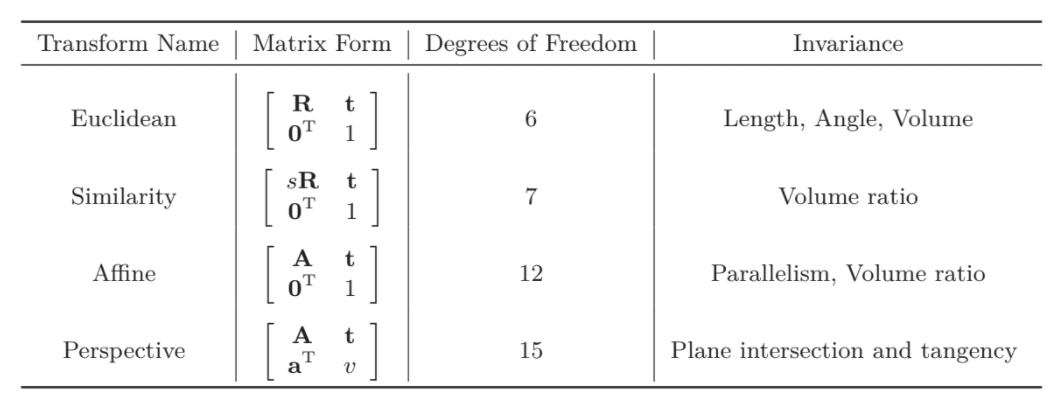
다른 변환도 잠깐 살펴보자